
Winning Well
Why being well and performing well are not the same


Before I get into the detail of wellbeing and performance this week, I have something to share with you that shows we really do mean it when we talk about this stuff at The Active Edge.
Those who are partial to a marathon, or just interested in the intricacies of endurance running, Coach Shane, Nicole, and professional marathon runner Abbie Donnelly (the 7th fastest British woman in marathon history) are hosting an evening on marathon preparation at Giant Store Lincoln on Friday 27th March. Three speakers, three angles, and not one of them is going to tell you to do more miles. The whole evening is built around the part of preparation that most runners never touch: the psychological side, the taper, and what actually matters when you are standing on that start line and your training log can no longer help you.

These posts are free. Sharing helps to support our writing and the time we put in… Thank you! Share
Well(being) then…
I’ve been bingeing Ted Lasso recently, and whilst it is full of nuggets, it has reminded me how often we conflate performing well with being well, as if one automatically guarantees the other.
The runner who nails a personal best and gets congratulated by everyone around them, but struggles to juggle the other parts of their life. Or more commonly is the opposite, where someone who is genuinely in a good place, connected, sleeping well, content, but whose performance has dipped and so they assume something must be wrong. We do tend to make these assumptions constantly. Good results must mean good health. Bad results must mean bad health. Most of us probably know that’s not the case, and yet we fall into that trap of questioning ourselves anyway. Well… I have a framework for this that I use all the time, and I think it might change how you look at your own situation
A Different ‘Active Edge’
Coaches, psychologists, and most people actually love a quadrant. We like fitting into boxes. So here are four boxes for you to put yourself in.
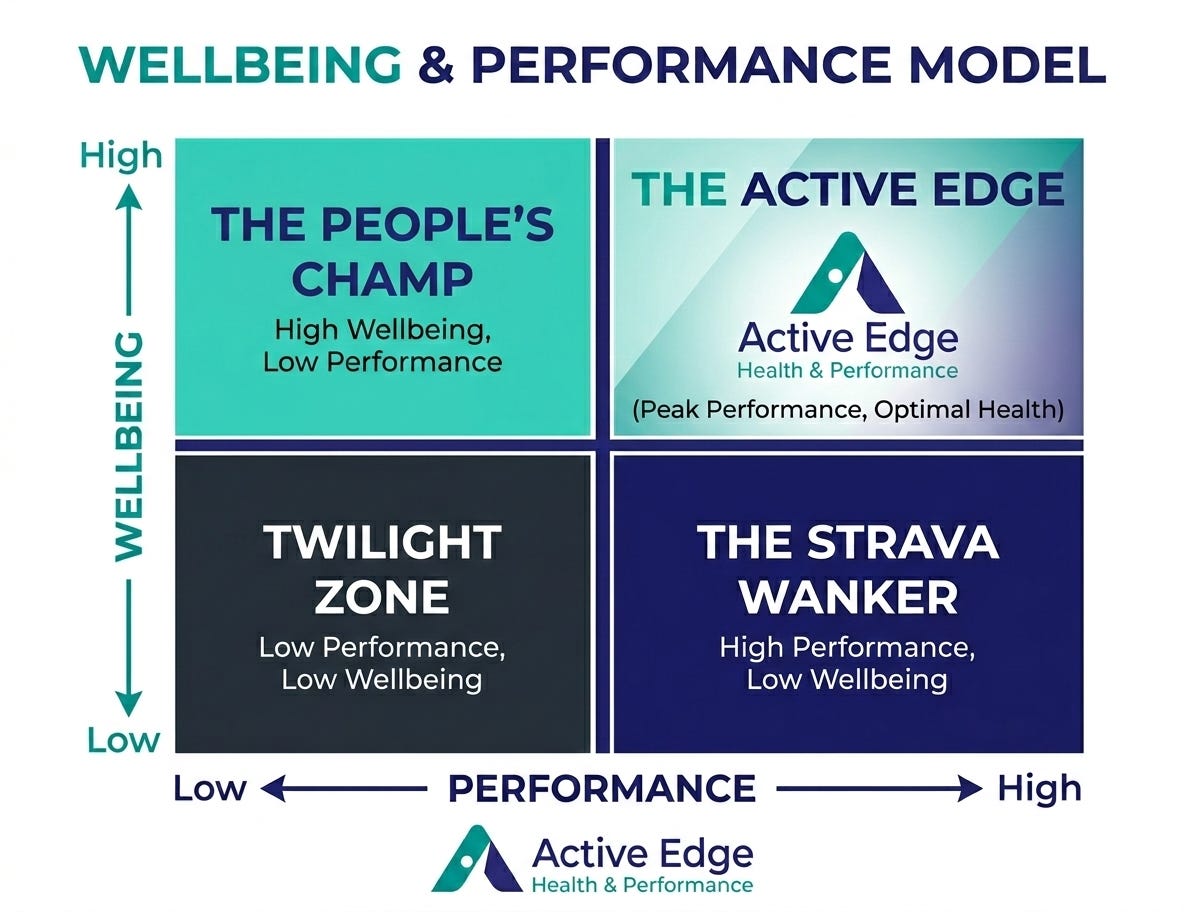
The Active Edge is where we all want to be, obviously. You feel well, you are performing well, the training is responding to what you are putting in. Life outside of sport is functioning. This is the zone where things click and you just find a nice flow. However, nobody lives in this section permanently. The Active Edge has to be worked for. Treating it as a permanent address is one of the quickest ways to lose it, because the moment things shift (and they always do) you start to assume something is fundamentally broken rather than understanding that movement around the quadrant is completely natural.
The People’s Champ is what I find most athletes struggle to accept. This is where your wellbeing is in a genuinely good place but your performance numbers have dipped or plateaued. Maybe you are coming back from injury. Maybe you have just finished an event and you are in recovery. Maybe, like I wrote about in I Don’t Want To Grow Right Now, you are in a maintenance period and your visible metrics are flat. If you read that piece, you will remember the idea that progress is not always visible, and that maintenance is mastery in a quieter phase. You do not need a harder training plan here. You need the patience to let the consolidation do its work. It is worth noting that a lot of people also become The People’s Champ after a period of genuine growth, having pushed hard, achieved something meaningful, and now finding themselves in a natural lull.
That lull is not regression. It is the body and mind catching up with what you asked of them.
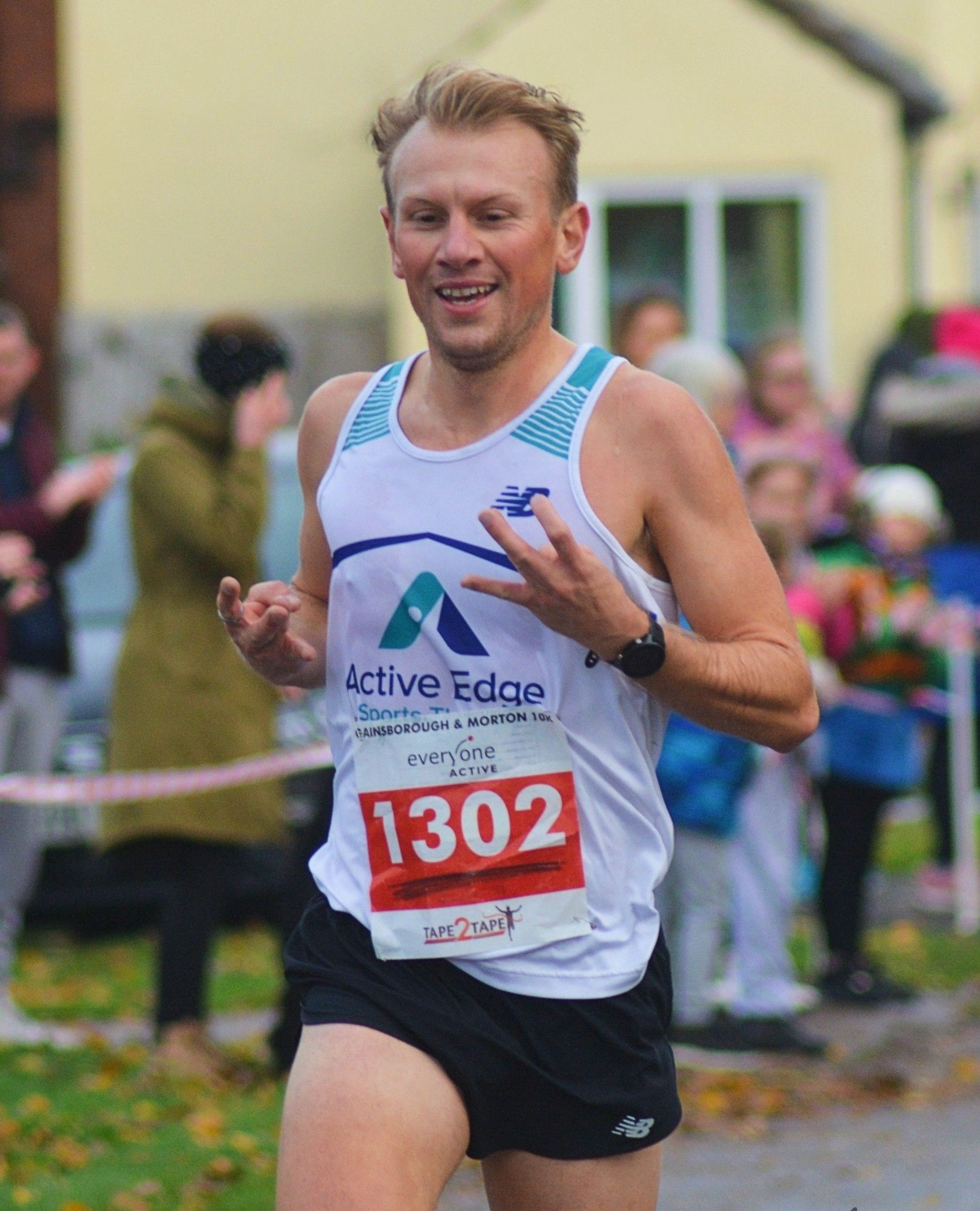
The Strava Wanker is where things get tricky, because from the outside it can look like everything is fine but underneath that, wellbeing is suffering. You are not sleeping properly, your relationships are strained, you are leaning on the structure of training to hold everything else together. I have been here. During 2021 and 2022 I was winning races, ranked 27th in the UK over 10k, and for a lot of that period I was loving life (and stealing segments). But towards the end, things shifted. I had personal stuff going on that I was not dealing with, and the results started covering for me. Winning Brighton 10k felt numb on the day, because it was masking a sadness that I was not letting myself sit with. Looking back at that stretch with honesty has meant admitting that there was a point where the performances kept climbing but I had already slipped into this quadrant without realising it. And that is exactly what makes it so tricky. You do not notice the slide because the numbers are still telling you a good story.
Shane talks about this from a different angle through the load and capacity framework. When your capacity is being eroded by stress, poor sleep, and emotional weight, then the load your training places on you becomes relatively heavier even if the sessions themselves have not changed. The Strava W*nker is essentially where load stays the same but capacity has quietly shrunk. And because the output still looks good on paper, nobody raises a flag. Least of all you.
The Twilight Zone is the hardest place to be, and the one we are most reluctant to acknowledge. Both wellbeing and performance have dropped. This is not a training problem. This is a life problem that needs proper support, and trying to train your way through it will only make things worse. Nicole has written about this before, and her work on what it actually means to see a Sport and Exercise Psychologist is worth reading too, because for a lot of people the biggest barrier is not knowing what that support looks like in practice.
This is not failure. It is a signal that something deeper needs attending to before performance can even re-enter the conversation. I think we need to normalise saying “I am here right now” without treating it as an admission of weakness. It is just information. And acting on it with the right support is one of the bravest things a person can do.
Your Running Hasn’t Gone To Shit
The reason I raise this framework is not because it gives answers but because it gives a starting point for better questions. When a client comes to me and says they are struggling, my first instinct isn’t to look at their training. It is to figure out which quadrant they are sitting in, because the appropriate response changes completely depending on where they are. The quadrant reframes everything. It turns “my running has gone to shit” into “which axis has shifted, and what does that actually need from me right now?”
This connects back to something that Nicole signed off with in her piece on not feeling great, a line that I think is one of the most important things we have published on Active Edge:
“feeling good and performing well are independent of each other.”
That single sentence is the foundation of this entire quadrant. Once you understand it, you stop using performance as a proxy for health, and you stop assuming that a dip in results means something is wrong with you as a person.
A Simple Check-In
I am not going to pretend that a quadrant system solves anything on its own. But what it can do is give you a framework for the kind of honest self-reflection that actually moves the needle, the sort of reflection we talk about in almost every edition of this newsletter. So here is what I would invite you to try.
Once a week, or once a fortnight, ask yourself two separate questions. Not as a combined feeling, but as two distinct assessments.
First: how is my wellbeing? Not my training, not my race preparation, not my Strava feed. My actual wellbeing. Am I sleeping? Am I connected to the people who matter to me? Am I present in my days? Do I feel like I am living in a way that lines up with what matters to me?
Second: how is my performance? Not my potential or my goals, but my current, honest output. Is my training consistent? Am I adapting? Do my sessions reflect where I want to be right now?
Then place yourself on the quadrant. And ask: does the type of work I am doing right now match the quadrant I am in?
If you are a People’s Champ and you are hammering intensity, there is a mismatch. If you are feeling a bit of a Strava Wanker and nobody around you knows it, there is a mismatch. If you are in the Twilight Zone and you are still pretending everything is fine, there is a mismatch.
The quadrant does not tell you what to do. It tells you what kind of question to ask next. And in my experience, that is usually the more valuable thing.
If you recognise yourself in one of these quadrants, know that you are not stuck there. We move around this thing constantly. The skill is not in avoiding the uncomfortable quadrants, because you will visit all of them at some point. The skill is in knowing where you are, so you can meet yourself with the right response rather than the instinctive one.
Go Well,
- Ron
Recommended Support
If you found this of value, then we value your support - Buy us a coffee
If you just fancy reading through some previous bangers:


Website, Videos and more: linktr.ee/theactiveedge
Email - info@activeedgesportstherapy.co.uk